
October 16, 2026
Cannabis Legalization in Canada: How We Got Here
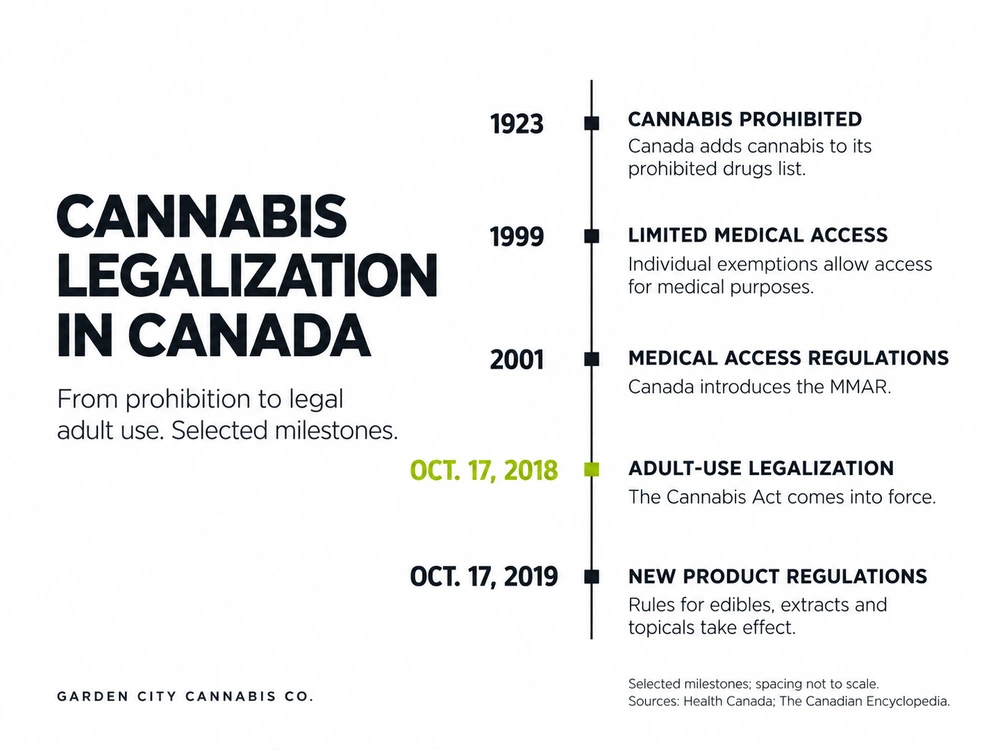
The key date in the timeline of cannabis legalization in Canada is October 17, 2018, when the Cannabis Act came into force and adult, non-medical cannabis became legal under a regulated framework. Health Canada’s explanation of the Act confirms the date.
But Canada did not move from prohibition to neighbourhood cannabis stores in a single step. Medical access developed first. Parliament passed the legislation before it took effect. Ontario’s first authorized stores opened later, and new product categories followed on another timeline.
At Garden City Cannabis Co., we think the backstory deserves a clear explanation. Whether you followed the headlines or simply wondered how we got here, this guide connects the major dates without making you read a stack of legislation.
Research checked: October 16, 2026. This is a selection of major milestones, not an exhaustive history of every cannabis law or court decision.
Jump to: Prohibition and early reform | Medical access | Adult-use legalization | Ontario and the rollout | Common questions
1923-1973: Prohibition and the first major calls for reform
1923: Canada prohibits cannabis
Canada added cannabis to its list of prohibited drugs in 1923, through an amendment to its federal drug law. Historical evidence presented to the Senate’s Special Committee on Illegal Drugs identifies this as the beginning of cannabis prohibition in Canada.
This is an important starting point: legalization in 2018 reversed a policy that had been in place for approximately 95 years. The period in between involved much more than one government changing its mind.
1969-1973: The Le Dain Commission questions criminal penalties
The federal government appointed the Le Dain Commission in 1969 to investigate the non-medical use of drugs. It held hearings across Canada and published reports between 1970 and 1973, examining the role of criminal law in responding to drug use.
In its 1972 cannabis report, a majority of the commissioners recommended removing criminal penalties for simple cannabis possession. The Government of Canada preserves the original report, and a Senate committee’s historical review explains the recommendations and the subsequent policy debate.
Those recommendations did not establish a legal retail market. They show, however, that the debate over criminal penalties began decades before the 2018 legislation.
1999-2016: Medical cannabis changes the legal picture
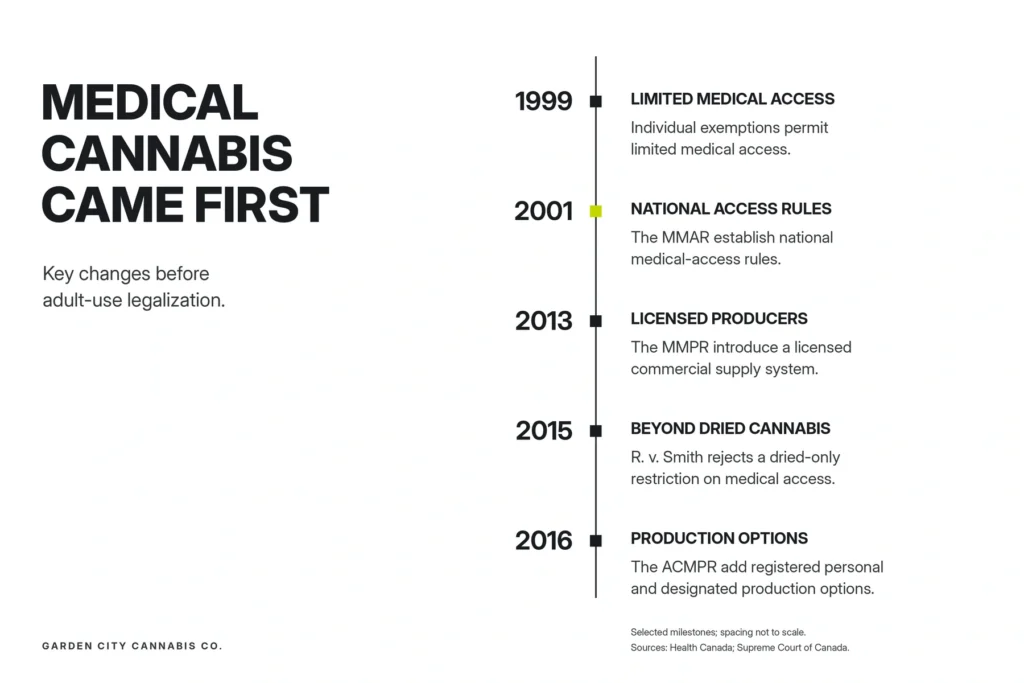
The next major changes concerned access for medical purposes, not a general right for adults to buy cannabis recreationally. That distinction matters throughout this part of the timeline.
1999: Limited legal medical access begins
In 1999, individual exemptions under section 56 of the Controlled Drugs and Substances Act provided limited legal access to dried cannabis for medical purposes. Health Canada’s history of medical-access regulations identifies these exemptions as the starting point. This was not adult-use legalization.
2000-2001: A court decision leads to national medical-access rules
The 2000 decision in R. v. Parker recognized the right of people with a medical need to possess cannabis for medical purposes. It led to the Marihuana Medical Access Regulations (MMAR) in 2001, as Health Canada explains.
The new framework permitted authorized patients to grow cannabis or designate someone to grow it for them; government supply also became an access route. This is why both 1999 and 2001 appear in histories of medical cannabis: the first refers to individual exemptions, the second to a national regulatory framework.
2013-2014: The system shifts toward licensed producers
The federal government introduced the Marihuana for Medical Purposes Regulations (MMPR) in 2013, creating a system centred on federally licensed commercial producers. Patients with the required medical documentation could register with a licensed producer and order directly.
The government’s 2013 announcement set out a transition into 2014. It is more accurate to describe this as a change in the medical supply system than as the year cannabis first became legal.
June 11, 2015: Medical access is not limited to dried cannabis
In R. v. Smith, the Supreme Court of Canada ruled that restricting lawful medical possession to dried cannabis violated the Charter.
The decision mattered because medical access could not be confined to the dried form alone. It did not create a nationwide recreational market for edibles. That later change belongs to the 2019 part of the story.
August 24, 2016: Medical production options expand
Following the Federal Court’s decision in Allard v. Canada, the Access to Cannabis for Medical Purposes Regulations (ACMPR) took effect on August 24, 2016.
As Health Canada’s announcement explains, authorized patients could register to produce a limited amount for their own medical use or designate a producer. Purchasing from a federally licensed producer remained an option.
The practical lesson from this period: patient access and court decisions helped reshape cannabis law well before adult-use legalization.
2016-2018: From planning to the Cannabis Act
June 30, 2016: Canada launches a legalization task force
Alongside changes to medical access, the federal government began developing a broader system. On June 30, 2016, it launched a task force and public consultation to advise on legalizing and regulating cannabis.
The work covered production, distribution, public health and enforcement. Importantly, the announcement itself did not legalize recreational cannabis. Existing prohibitions remained in force while the government developed the legislation.
April 13, 2017: Bill C-45 is introduced
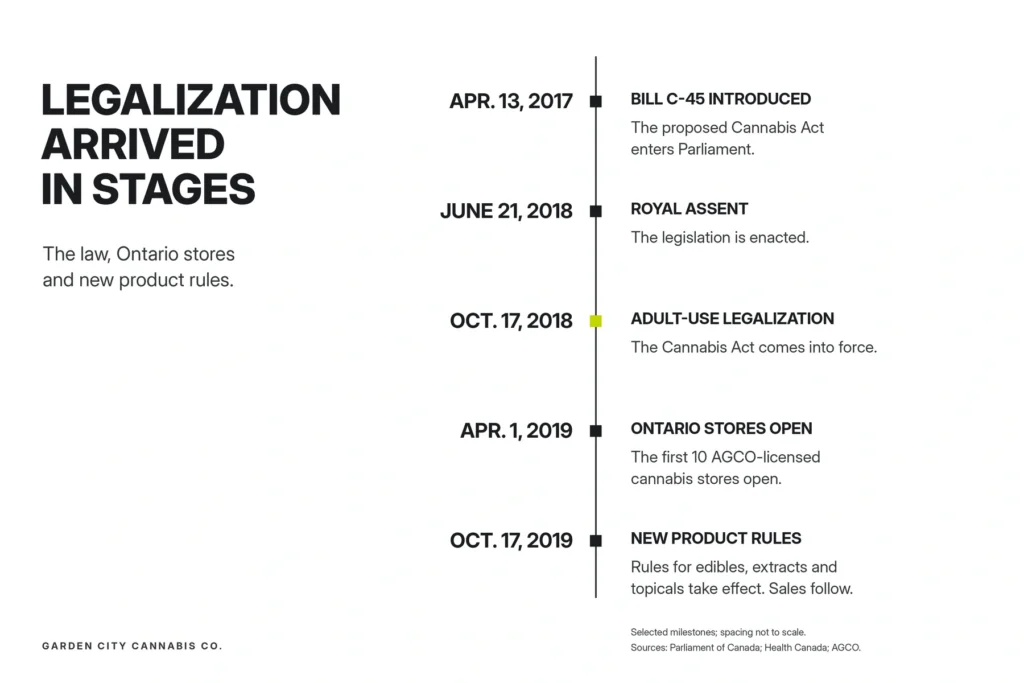
Bill C-45, the legislation that would become the Cannabis Act, received its first reading in the House of Commons on April 13, 2017. The official parliamentary record tracks its progress through the House of Commons and Senate.
The proposal was for a regulated system, not unrestricted access. Age restrictions, legal supply and rules governing possession and sale were central to the framework.
June 21, 2018: The Cannabis Act receives Royal Assent
Bill C-45 received Royal Assent on June 21, 2018, as confirmed by Parliament of Canada.
The distinction matters. Royal Assent meant the legislation had been enacted. It did not mean the adult-use framework was already in operation. The main legalization provisions would take effect in October.
October 17, 2018: Adult-use cannabis becomes legal
On October 17, 2018, the Cannabis Act came into force, establishing a legal framework for adult, non-medical cannabis. Health Canada’s explanation of the Act outlines its controls over production, distribution, sale and possession.
The shift was from broad prohibition to regulated access. It included legal sources of supply and possession limits, while activities outside the framework could still attract penalties. Legal did not mean unregulated.
The Department of Justice’s overview also explains the division of responsibilities: federal law establishes the national framework, while provinces and territories shape distribution and retail systems and can impose additional restrictions.
2019 onward: Ontario stores, new products and further changes
April 1, 2019: Ontario’s first authorized cannabis stores open
Ontario did not begin with the storefront system people recognize today. At legalization in October 2018, the province introduced legal online sales through the Ontario Cannabis Store (OCS).
On April 1, 2019, 10 of Ontario’s initial 25 approved storefronts were ready to open, including one in St. Catharines. The Ontario government’s 2019 Budget confirms when the storefront rollout began, while CHCH’s opening-day coverage confirms St. Catharines was among the first communities with an operating licensed store.
For readers in St. Catharines, Welland, Fort Erie and across Niagara, this explains an important distinction: Canada’s legalization date and Ontario’s storefront opening date are not the same.
August 1, 2019: An expedited record-suspension process begins
Legalization did not automatically erase previous cannabis convictions. On August 1, 2019, the federal government introduced an expedited record-suspension process for people convicted only of simple cannabis possession, removing the application fee and waiting periods.
A record suspension is not the same as erasing a conviction. The Parole Board of Canada explains the distinction and eligibility requirements, including that obtaining supporting documents can still involve costs.
October 17, 2019: Rules expand to edibles, extracts and topicals
A year after adult-use legalization, updated federal regulations established the rules for the legal production and sale of edible cannabis, cannabis extracts and cannabis topicals. Health Canada dates those changes to October 17, 2019.
That was the regulatory start date, not a promise that every new product would be on shelves that morning. Health Canada explained that products would appear gradually beginning in mid-December, after the required notification period. Its December 2019 rollout statement provides the contemporary account.
This was also not the first time any cannabis oil had been legal. Certain oils were already permitted under the 2018 framework. The 2019 changes broadened and reorganized the permitted product categories.
2020: Ontario moves beyond its initial retail lotteries
Ontario’s early store allocation used lotteries and limits. In 2020, the province moved toward a more open licensing process.
Under the new system, the Alcohol and Gaming Commission of Ontario began accepting retail operator licence applications on January 6, 2020, followed by retail store authorization applications on March 2, 2020. The Ontario government’s announcement confirms the schedule, and the historical Ontario regulation records the phase-out of the earlier allocation restrictions. Retailers still needed the required licences and authorizations.
2024-2025: The framework is reviewed and adjusted
Legalization was not the final policy decision. In March 2024, an independent expert panel published its legislative review of the Cannabis Act, examining issues including public health, medical access, the illicit market and impacts on Indigenous peoples and communities.
On March 12, 2025, further regulatory amendments took effect, changing requirements in areas such as licensing, production, packaging and labelling. These were changes within an existing legal system, not a new legalization date.
What does legalization mean for someone in Niagara?
The national history explains how the system developed. Ontario’s rules explain how it applies locally.
Under Ontario’s cannabis laws, you must be 19 or older to buy, use, possess or grow recreational cannabis. The general public-possession limit is 30 grams of dried cannabis or its equivalent, and restrictions apply to where cannabis can be consumed. Medical access operates under different rules.
There is also a particularly relevant point for a border region: Canadian legalization does not give travellers permission to take cannabis into the United States or bring it back. Without the required government authorizations, carrying cannabis across Canada’s international border remains illegal, even when it is legal at the destination. Consult the Government of Canada’s border guidance before travelling.
Cannabis legalization in Canada: common questions
When was cannabis legalized in Canada?
Adult, non-medical cannabis became legal on October 17, 2018, when the Cannabis Act came into force. Royal Assent took place earlier, on June 21, 2018. Health Canada confirms the commencement date.
Was medical cannabis legal before 2018?
Yes. Limited legal access began through individual exemptions in 1999, followed by national medical-access regulations in 2001. Those arrangements were distinct from the later adult-use market. See Health Canada’s medical-access history.
Why do some timelines list 2019 as well as 2018?
They refer to different milestones. Adult-use legalization took effect in 2018. Ontario’s first authorized storefronts began opening in April 2019, and new rules for edibles, extracts and topicals took effect in October 2019.
Is legalization the same as decriminalization?
No. Decriminalization generally removes criminal penalties for specified conduct, such as possession; it does not necessarily establish a legal supply chain. Canada’s legalization framework went further by regulating activities including production, distribution and sale, while retaining offences outside the legal system.
A national timeline. A local conversation.
From the first medical exemptions to Parliament’s votes and Ontario’s store openings, the timeline explains why there is no single date that tells the whole story.
At Garden City Cannabis Co., we’re Niagara’s hometown cannabis store. We believe straightforward information belongs in the conversation, whether you’re familiar with cannabis or just curious about the history. Explore more stories and explainers on the GCCC blog.
This article is for general educational purposes, not medical or legal advice. Historical sources describe the rules at that time; consult current government guidance for rules that apply today.
Join our mailing list to receive exclusive details on new arrivals, product recommendations, sales, discounts, events and more.




111 Fourth Avenue, Unit 9
St. Catharines, Ontario
(905) 397-4207
310 Garrison Rd
Fort Erie, Ontario
(905) 871-4420
623 Niagara Street
Welland, Ontario
(289) 820-8432
469 East Main St
Welland, Ontario
(289) 820-6370
